Choosing the right resilient flooring is a system decision. The wear layer, the core density, the backing of the floor, as well as the subfloor and the area where the flooring is to be used, all have to be taken into account. Within this comparison between LVT, WPC flooring and SPC flooring, we will explain the differences between the three types of flooring and where we see their use to be most practical. UTOP SPC FLOOR supplies LVT and SPC flooring, both for domestic and for commercial use. Our advice as to which type of flooring is the best for your needs is based on the required performance and not on the material itself.
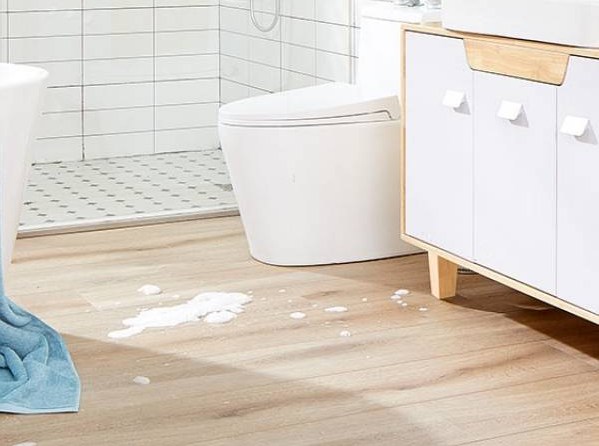
LVT is a flexible luxury vinyl tile or plank. Its PVC-based construction follows minor substrate variation more readily, but it also telegraphs ridges and benefits from careful adhesive or loose-lay preparation. WPC uses a foamed, more resilient core that feels warmer and softer underfoot. SPC uses a mineral-filled rigid core, which improves indentation resistance and dimensional stability but transfers more subfloor irregularity to the installation. “Waterproof” describes the plank or tile material; it does not make a damp concrete slab suitable for a floating floor. The practical comparison is therefore not simply LVT vs WPC vs SPC cost. It is flexibility versus rigidity, comfort versus load response, and initial material cost versus preparation and maintenance over service life.
The softest step is achieved by WPC flooring, as the foamed core of the product will compress slightly when walking on it. LVT flooring, on the other hand, offers comfort by using a resilient underlayment, approved for use with this flooring type. SPC flooring is generally harder and more rigid than LVT flooring. Acoustic performance in apartment bedrooms and hotels may also be a requirement, and a soft layer such as IXPE or EVA is often used as a backing for this type of flooring; the same layer can be used as a backing for acoustic purposes depending on the product. For UTOP SPC FLOOR, project materials typically offer optional 1.0-2.0 mm backings, but an additional soft layer must not be added without reference to the manufacturer’s instructions, as excessive vertical movement may place excessive stress on click joints.

The surface wear layer is responsible for protecting the printed design of the flooring, while the core provides the support for the flooring to flex. The typical thickness of the core layer for SPC flooring planks is 3.5mm, 4mm, 5mm, 6mm and 7.0mm, with various surface wear layers at 0.2mm, 0.3mm, 0.5mm and 0.7mm. Although increasing the thickness of the flooring does not automatically increase the durability, other factors can influence this, including the amount of foot traffic that the flooring will receive, the flooring’s ability to resist rolling movement, the floor substrate, and the locking system of the floor plank. In contrast to WPC flooring, tests comparing the durability of WPC flooring vs SPC flooring have shown that SPC flooring is generally more durable due to its greater ability to withstand high levels of indentation force and to resist movement caused by items of furniture, changes in temperature, and use in commercial environments. However, WPC flooring does offer greater comfort under moderate loads.
A cost comparison of LVT, WPC, and SPC flooring products should be based on a like-for-like basis such as thickness, wear layer, design print, floor covering locking system, backing material, and order quantity. Although some of the adhesives for LVT products may be priced lower than those for WPC and SPC products, the amount of subfloor smoothing and application of adhesive required can often make up for the initial lower cost of the product. In general, WPC flooring products are more expensive than basic LVT products due to the comfort core within the product; however, SPC products generally have a more expensive core specification but can be installed using a click system, thereby reducing the amount of wet application of adhesive required and enabling the contractor to walk on the floor and start using the floor sooner. When comparing the cost of these products, allow for full installation, including for example: moisture testing, patching up, levelling, vapor control, underlayment, heel scratches, scuffing and general wear as well as trims and transitions. Concrete subfloors for resilient flooring must be dry, clean, smooth, and structurally sound to comply with ASTM F710 and therefore require moisture testing regardless of the age or grade of the concrete slab.
The selection of LVT is generally driven by projects that require flexible flooring, which can be bonded using adhesive and provides minimal flooring thickness. WPC flooring is selected to provide underfoot warmth and excellent acoustic performance. SPC flooring is selected as a firm floating floor solution that is easily cleaned and offers greater resistance to furniture indentation than LVT. Water resistance of flooring does not overcome the requirement to manage water at edges and joints of floors.
For offices, retail, apartments and hospitality, compare wear-layer thickness, rolling-load performance, dimensional stability, acoustic targets and replacement strategy. UTOP SPC FLOOR offers application-led collections including commercial, residential, quiet, wood-look and stone-look SPC flooring. Our technical data should be checked against the project traffic class and local specification rather than inferred from appearance alone.
Start with five measured inputs: room use, rolling or static loads, acoustic target, subfloor condition, and installation window. Then shortlist constructions by wear layer and core, confirm permitted underlayment, and review transitions and perimeter movement space. For concrete, use a quantitative method such as ASTM F2170 in-situ relative humidity testing or ASTM F1869 moisture vapor emission testing, following the product acceptance limit. A plastic-sheet spot check can reveal obvious condensation but cannot replace the specified test.
A simple process to choose your SPC flooring: survey – test – repair – verify – specify – install. By using the UTOP SPC FLOOR Floor Finder, you can even narrow down to specific areas of application, surfaces, thicknesses, and backings. For more detailed information on commercial SPC flooring’s installation and maintenance when there is a lot of repeated traffic, please click here to view our whole offer.
A comparison of the various flooring options, LVT, WPC and SPC, can reveal the best solution to a given flooring specification. Importantly, no form of flooring can compensate for a wet, weak or uneven substrate. By matching a floor’s core type, wear layer, backing and installation details to the specific circumstances of a given project, the buyer can influence both price and serviceability. UTOP SPC FLOOR works with the buyer to specify a suitable floor covering which will remain serviceable after the initial impressive showroom appearance has worn off.
A) LVT is made from flexible vinyl, WPC includes a softer foamed core to offer more underfoot comfort, while SPC features a mineral-filled rigid core to provide increased support and greater dimensional stability. Each product has its own unique benefits and will be better suited to certain applications based on traffic, acoustic requirements, subfloor, and method of installation.
A: For heavy furniture, frequent walking, and soft indentation, SPC flooring is generally the better choice because the rigid core of SPC flooring bears more weight with less compression than WPC flooring. For floors with a WPC core, the comfort and sound-reducing properties are more important than the service life for moderate loads. The service life of flooring also greatly depends on the wear-layer thickness and the adequate subfloor preparation.
A cost ranking of flooring products cannot be given without detailed specification of thickness, wear layer, backing, locking mechanism, and method of installation, as well as order quantity. LVT may offer lower material cost in some forms, whereas WPC and SPC add cores to deliver performance. A full cost analysis must include allowance for floor preparation, moisture testing, underlay, edging and other trim items and for labor to install the flooring.
A: Yes, provided the concrete is dry, clean, smooth, and structurally sound. Moisture should be checked with the method required by the project specification, such as ASTM F2170 or ASTM F1869. Repair ridges, depressions, and moving joints before installation, and follow the technical instructions for the selected UTOP SPC FLOOR product.


